

The Best AI Tools for Solopreneurs in 2025
Look, I’ve spent months testing AI tools across 70+ solopreneur categories, and most of the hype is just that — hype.
But after digging into comprehensive research data showing potential time savings from 4.5 to 35 hours per week depending on your business type, I’ve identified the best AI tools that deliver transformative results for small business owners who know where to focus.
The data doesn’t lie: most successful solopreneurs can reclaim 11.5 hours per week on average. Read the full study here.
That’s nearly 600 hours annually — equivalent to adding a part-time employee without the overhead costs.
Here’s what actually works for the highest-impact categories.
The Data-Driven Reality: Not All Categories Are Equal
Before diving into specific tools, let’s address the business world reality that ai tool lists rarely acknowledge: your solopreneur category determines your automation potential.
Recent research analyzing 51 distinct categories reveals that 61% fall into the “medium-impact” range of 8-15 hours saved weekly, while 21% achieve “high-impact” savings of 15+ hours per week.
The power of artificial intelligence isn’t universal — it’s category-specific. Small business owners in data-heavy roles see dramatically different results than physical service providers.
Understanding your category’s potential is crucial for data-driven decisions about tool investment.
Transcriptionists: The 35-Hour Revolution
Transcriptionists represent the ultimate use case for AI transformation, with potential weekly savings of 25-35 hours.
AI-powered tools can automate 80-90% of manual transcription work, fundamentally changing the business model from time-trading to capacity scaling.
-
- Otter.ai leads the pack for real time transcription with speaker identification and automated summarization.
The user-friendly interface requires minimal learning curve, and the free plan offers enough functionality for small teams to test effectiveness. For content creators handling interviews and meetings, Otter’s integration capabilities eliminate hours of data entry.
-
- Rev.ai provides enterprise-grade accuracy for client work requiring professional standards.
The platform excels at handling video content transcription, making it invaluable for content creation workflows.
Customer satisfaction remains high due to consistent quality — a good thing when your brand identity depends on accuracy.
-
- Tactiq specializes in meeting transcription and summarization, saving 3-4 hours weekly on post-meeting routine tasks.
The AI automatically generates action items and key takeaways, transforming customer interactions into actionable insights without manual processing.
Bookkeepers: Automating 20-30 Hours Weekly
Bookkeeping represents another high-impact category where generative ai tools can eliminate 20-30 hours of weekly work through automated data analysis and processing.
The business operations transformation is dramatic — moving from manual data entry to strategic financial oversight.
-
- Zeni.ai provides comprehensive AI bookkeeping that automates invoicing, expense tracking, and cash flow management.
The platform’s predictive insights help with data-driven decisions about business growth, while real time financial dashboards eliminate the stress of manual tracking.
For small businesses, this represents a valuable resource that reduces reliance on expensive accounting services.
-
- Docyt excels at document processing and categorization, automatically handling receipts, invoices, and financial documents.
The AI learns your specific needs and improves accuracy over time. Customer support is responsive, and the free version offers substantial functionality for testing.
-
- Booke AI focuses on error detection and financial reconciliation, catching discrepancies that manual processes often miss.
This powerful tool ensures customer satisfaction by maintaining accurate financial records — essential for business strategy and tax compliance.
Videographers: 20-25 Hours of Creative Freedom
Video professionals can reclaim 20-25 hours weekly through AI-powered editing and post-production automation.
These new tools level the playing field between solo creators and large teams with dedicated editing resources.
- Veo delivers AI-powered video generation that transforms text prompts into professional-quality footage without requiring cameras or production teams.
The platform creates realistic scenes and cinematic sequences, making it a game-changer for content creators who need high-quality video content on demand.
For marketing teams and social media managers, this innovative tool eliminates the expensive process of traditional video production while maintaining visual appeal.
- Descript revolutionizes video editing with text-based editing capabilities.
You edit video by editing the transcript — a good idea that eliminates the traditional timeline complexity.
The AI automatically removes filler words, generates captions, and creates social media posts from longer content.
For content creators, this helpful tool transforms hours of editing into minutes of refinement.
- Runway ML provides AI-powered visual effects and background removal that previously required expensive software and different skills.
The platform enables viral video creation with professional polish, making it a valuable resource for social media platforms content.
- Synthesia creates AI-generated presenter videos, eliminating the need for on-camera time while maintaining personal connection.
For educational programs and online courses, this technology saves long time periods spent on recording and re-recording content.
Virtual Assistants: Scaling Without Limits
Virtual assistants can save 15-20 hours weekly by leveraging ai-powered tools for customer service, project management, and administrative tasks. The category benefits from addressing multiple universal pain points simultaneously.
- Notion AI serves as a comprehensive workspace that handles content creation, project management, and knowledge organization.
The platform’s AI capabilities assist with generating ideas, blog posts, and marketing materials while maintaining centralized client information. For team members coordination (even if that’s just you), Notion’s user-friendly interface requires minimal learning curve.
- Cody AI provides personalized business automation that learns your specific needs and client work patterns.
The platform excels at customer interactions and email management, automatically categorizing and responding to routine inquiries. Customer engagement improves through faster response times without sacrificing quality.
- Zapier’s AI features connect disparate tools into automated workflows, eliminating repetitive tasks across platforms.
For virtual assistants managing marketing campaigns and customer support across multiple clients, these integrations save hours of manual data entry and coordination.
Social Media Managers: Content at Scale
Social media management represents a high-impact category where ai-powered tools can save 15-20 hours weekly on content creation and customer engagement.
The focus shifts from manual posting to strategy and relationship building.
- Buffer AI automates social media posts scheduling and provides real time analytics for optimization.
The platform’s AI suggests optimal posting times for target audience engagement and automatically generates social posts variations. For small business owners managing multiple social media platforms, this essential ai tools integration eliminates daily posting stress.
- Tweet Hunter specializes in Twitter/X content creation and customer engagement.
The AI analyzes viral patterns and suggests content that resonates with your target audience.
The free plan offers substantial functionality for testing, while premium features include automated thread creation and engagement tracking.
- Jasper excels at marketing materials creation across platforms.
The AI understands brand identity and maintains consistent voice across blog posts, social media posts, and email marketing campaigns. For content creators managing marketing campaigns, Jasper’s content creation capabilities eliminate writer’s block and ensure consistent output quality.
SaaS Founders: Technical Automation
SaaS founders can save 15-20 hours weekly through ai-driven platforms that automate customer support, data analysis, and product development insights.
The cutting-edge technology available today enables single founders to operate like large teams.
- Intercom’s AI features provide ai-powered chatbots that handle customer service inquiries automatically.
The system learns from customer interactions and improves response quality over time. Customer satisfaction increases through 24/7 availability while founders focus on product development rather than repetitive tasks.
- Mixpanel’s Spark AI insights automate data analysis and provide actionable product intelligence.
The platform identifies user behavior patterns and suggests optimization opportunities without manual data mining. For business strategy decisions, these insights prove invaluable for business growth.
- GitHub Copilot accelerates code development and documentation, effectively adding a team members equivalent for development work.
The AI suggests code completions and identifies potential bugs, reducing development time and improving code quality.
Content Creators: The Universal High-Impact Category
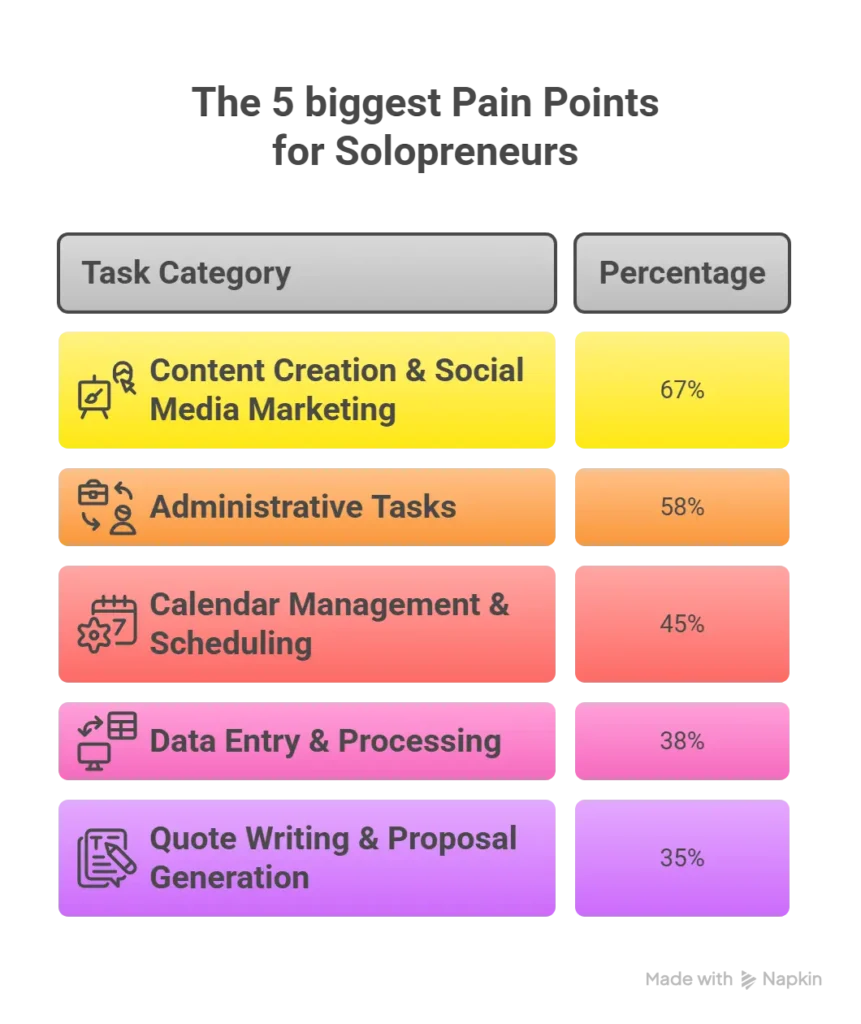
Content creation affects 67% of all solopreneur categories, making ai-powered tools in this space universally valuable.
Content creators specifically can save 12-18 hours weekly through comprehensive automation.
- ChatGPT Plus and Claude Pro provide powerful tool capabilities for content creation, research, and generating ideas.
These platforms excel at blog posts creation, email marketing copy, and marketing materials development.
The learning curve is minimal, and both offer free version testing before commitment.
- Grammarly‘s AI features go beyond spell-checking to provide style and tone optimization.
For content creators maintaining brand identity across client work, Grammarly ensures consistency and professionalism.
The user-friendly interface integrates seamlessly with existing writing workflows.
- Canva’s AI design tools automate marketing materials creation and social media posts design.
The platform’s Magic Design feature generates professional visuals based on text prompts, eliminating the need for different skills in graphic design. For small business owners creating video content thumbnails and promotional materials, Canva saves hours of design work.
The ROI Reality: Why These Tools Pay for Themselves
The economics are compelling across all high-impact categories.
With median time savings of 11.5 hours weekly, the annual value creation reaches $29,900 for a $50/hour professional.
For transcriptionists saving 30 hours weekly, the annual value exceeds $78,000, while bookkeepers reclaiming 25 hours weekly generate $65,000 in annual value.
Even conservative tool investments of $3,000-5,000 annually deliver extraordinary returns.
Implementation Strategy: The 90-Day Transformation
Today’s digital age rewards systematic implementation over scattered tool adoption.
Phase one focuses on your category’s highest-impact use case — typically content creation or administrative tasks.
Master one powerful tool completely before expanding.
Phase two introduces secondary automation, ensuring integration with existing business operations.
For high-impact categories, this might mean connecting transcription tools with project management platforms or linking bookkeeping automation with customer service systems.
Phase three optimizes workflows and explores advanced features.
The best part of modern ai-powered tools is their continuous improvement — features that seem advanced today become standard routine tasks automation tomorrow.
What Doesn’t Work: Common Implementation Failures
Not every helpful tool deserves your attention.
Free ai tools often lack the sophistication required for professional client work.
Educational programs and online courses frequently oversell basic AI capabilities while underselling implementation complexity.
To-do list apps with AI features sound useful but rarely address the core repetitive tasks that consume hours.
Your business strategy doesn’t need another layer of digital complexity — it needs automation that eliminates real bottlenecks.
Video content tools promising viral video creation often lack the nuanced understanding required for brand identity maintenance.
AI-generated images work well for some marketing campaigns but struggle with consistent visual branding across social media platforms.
The Competitive Reality: Act Now or Fall Behind
The business world is rapidly dividing into AI-adopters and those struggling with manual processes.
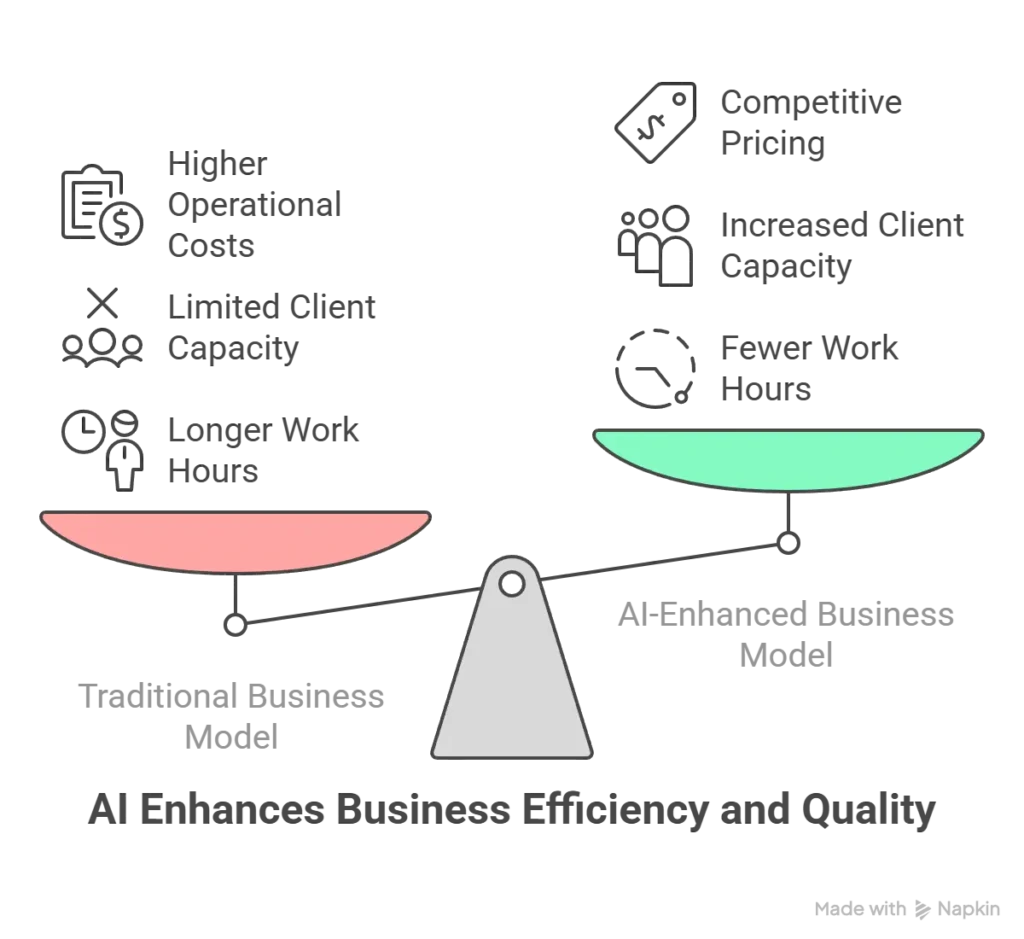
High-impact categories show the most dramatic splits — most successful solopreneurs in transcription, bookkeeping, and video editing are already using ai-powered tools to deliver better results at competitive prices.
Small business owners who delay adoption risk being displaced by more efficient competitors.
The opportunity window narrows as ai-driven platforms become standard in high-impact categories. Early adopters capture market share while late adopters struggle with cash flow and capacity constraints.
Looking Forward: The Transformation Continues
Cutting-edge technology continues evolving, but the fundamental advantage belongs to solopreneurs who master current essential ai tools rather than waiting for perfect solutions.
Business ideas that incorporate AI from inception have advantages, but existing small businesses can benefit equally through strategic implementation.
The power of artificial intelligence lies in augmenting human capabilities in high-impact categories.
Data-driven decisions become easier when you have tools providing insights, but success still requires good idea execution and consistent effort.
The Bottom Line for High-Impact Categories
For transcriptionists, bookkeepers, videographers, virtual assistants, social media managers, SaaS founders, and content creators, ai-powered tools represent the difference between sustainable growth and competitive obsolescence.
The valuable resource here isn’t the tools themselves — it’s the time and mental energy they free up for strategic business growth.
Start with your category’s highest-impact use case.
Master one powerful tool that addresses your biggest time drain. Then expand systematically, ensuring each addition integrates with your existing business operations.
That’s how you win in today’s digital age.
The numbers don’t lie: high-impact categories can reclaim 15-35 hours weekly through strategic AI adoption.
Whether you’re transcribing, bookkeeping, editing videos, or managing social media, the right ai tools exist today to transform your business model from time-trading to value-scaling.
Don’t get caught up in the hype. Focus on tools that solve real problems in your specific category, offer testing through free plan options, and integrate well with your existing workflow.
That’s how you capture the extraordinary ROI that high-impact categories achieve through ai-powered tools. Read more about the latest research on 70 solopreneur categories.

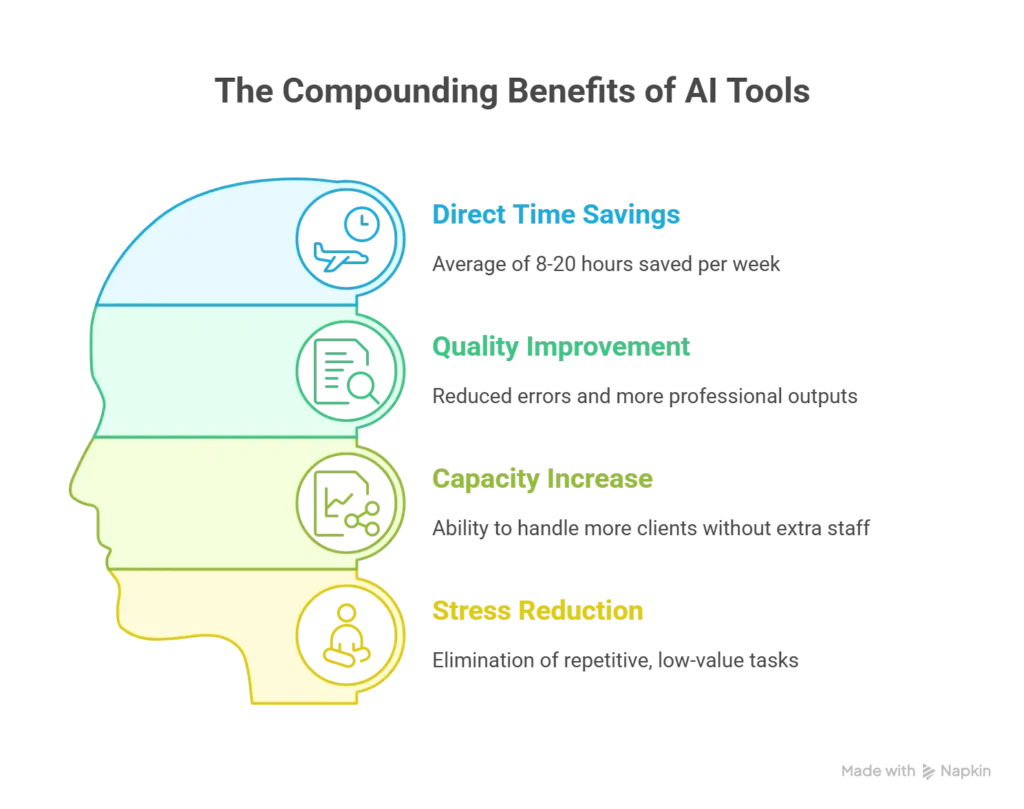 They’ve figured out the right tools, refined their workflows, and built sustainable competitive advantages.