Claude Connectors: How to build Self-Improving AI Tools

Claude Connectors - building self-improving AI tools

Claude just recently added connectors. So what possibilities do the new connectors make possible? They’re actually changing the game.

After spending weeks building AI assistants that can literally improve themselves, I can tell you this isn’t just another overhyped feature — it’s the real deal.

The big idea here isn’t just automation.

It’s creating an informed AI collaborator that gets smarter every time you use it, automatically updating its own instructions based on what it learns.

Think of it as having a helpful assistant who not only follows your processes but actively makes them better without you having to micromanage every detail.

Why Claude Connectors Matter More Than You Think

Remember when setting up AI automation meant wrestling with APIs, configuring servers, and spending hours debugging connection issues?

Those days are over.

Claude’s new connectors work with a simple toggle switch — no technical expertise required.

What makes this different from other AI automation tools is the new directory of tools available.

We’re talking about direct integration with Google Workspace, Notion, project management tools, and even local desktop applications.

But here’s the kicker: these aren’t just one-way connections.

Claude can read, write, and update information across all these platforms in real-time, functioning as a true informed AI collaborator.

The Three-Phase Process That Actually Works

After testing dozens of different automation workflows with these latest features, I’ve landed on a three-phase approach that consistently delivers results:

    1. Process Documentation — Before you automate anything, you need to document what you’re actually trying to do. This sounds obvious, but most people skip this step and wonder why their helpful assistant keeps going off the rails.
    2. Creating Instructions — Convert your documented process into step-by-step instructions that Claude can follow. The key here is keeping the human in the loop for approval at each stage, treating Claude as an informed AI collaborator rather than a mindless automation tool.
    3. Iterative Improvement — This is where the magic happens with these new connectors. Your AI assistant learns from each session and automatically updates its own instructions to work better next time.

Step-by-Step: Building Your First Self-Improving Assistant

Let me walk you through exactly how to set this up using the latest features, with a real example I’ve been working with — converting research documents into social media content.

Setting Up Your Connectors

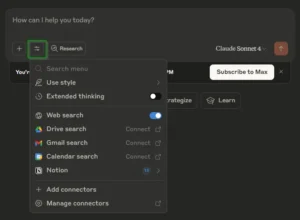
how to activate claude connectorsFirst, head to claude.ai and look for the connector slider in the interface. You’ll see options for web search, Google Drive, Gmail, Calendar, and others in this new directory of tools.

For this example, we need Google Drive and Notion connectors.

Enabling these new connectors is stupidly simple.

The Google services are just toggle switches. For Notion, click “Connect,” authorize the connection, and you’re done.

No MCP server setup, no configuration files — just click and go.

If you’re using the desktop version, you’ll also have access to local desktop applications like PDF handlers and system controls.

Phase 1: Document Your Process

Start with this prompt (customize it for your specific use case):

“Can you help me create a robust process for converting my research documents in Google Drive into actionable social media posts? I want to use Claude connectors to automate as much as possible.”

Claude will automatically search your Google Drive, analyze your existing documents, and create a detailed process based on what it finds.

The cool part? It pulls from your Claude profile preferences, so the output matches your style without you having to explain everything from scratch.

This is where having an informed AI collaborator really pays off.

Phase 2: Convert to Instructions

Once you have your documented process, use this prompt:

“Can you convert this process into a set of instructions I can use inside of a Claude project? Make sure to loop the user in for approval feedback with each step.”

This gives you a step-by-step instruction set that keeps you in control while automating the heavy lifting.

Your helpful assistant will handle the routine work while still checking in with you on important decisions.

Phase 3: The Self-Improvement Setup

Here’s where it gets interesting with these latest features. Instead of pasting those instructions directly into a Claude project, put them in a Notion page (or Google Doc).

Then, in your Claude project instructions, simply reference that document with a link.

Add this crucial line at the end of your project instructions:

“Important: Once the session is over, please work with the user to update these instructions based on things that were learned during the recent session.”

Now your informed AI collaborator will automatically suggest improvements to its own process after each use, leveraging the full power of the new connectors.

What Works (And What Doesn’t)

After extensive testing with the new directory of tools, here’s what I’ve learned:

The Good:

    • Google Workspace integration is rock-solid
    • Notion connectivity works great for knowledge management
    • Gmail search can save hours of manual email sorting
    • Web search integration eliminates constant copy-pasting
    • Local desktop applications integration (when using desktop Claude) opens up powerful automation possibilities

The Not-So-Good:

    • Canva connector is basically useless (don’t waste your time)
    • Gmail can over-summarize important details
    • Some new connectors have rate limiting that isn’t clearly documented

Advanced Tips for Power Users

    1. Use Version Control: Number your instruction documents (like “Process_v2.3”) so you can track improvements over time as your helpful assistant evolves.
    2. Set Boundaries: Define what your informed AI collaborator should and shouldn’t do. Without guardrails, it’ll make assumptions that derail your workflow.
    3. Test Small: Start with simple processes before building complex multi-step workflows using the latest features. I learned this the hard way after watching Claude generate 47 social media posts that completely missed the mark.
    4. Desktop Extensions: If you use the Claude desktop app, experiment with local desktop applications integration including PDF handling and Mac control features. They’re surprisingly capable and represent some of the most powerful new connectors available.

The Two-Hour Work Week Challenge

Here’s something to think about: if you could only work two hours per week on your business, what would you focus on?

With these new connectors and the expanded new directory of tools, you can get dramatically more done in those two hours than was possible even six months ago.

The key is thinking in terms of delegation, not just automation.

You’re not just eliminating tasks — you’re creating an informed AI collaborator that handles entire workflows while you focus on strategy and creative work.

Common Pitfalls to Avoid

    1. Over-optimization: Don’t try to automate everything at once with the new connectors. Build one solid workflow before moving to the next.
    2. Too-rigid instructions: Leave room for your helpful assistant to adapt to edge cases and unexpected situations.
    3. Ignoring feedback loops: Always review what your informed AI collaborator produces and feed that learning back into the system.
    4. Poor documentation: If you can’t explain the process to a human, the AI won’t understand it either, regardless of how advanced the latest features are.

The Bottom Line

Claude’s new connectors aren’t just another productivity hack — they’re a fundamental shift in how we can work with AI.

For the first time, we have access to a comprehensive new directory of tools that creates a true informed AI collaborator rather than just a helpful assistant.

The learning curve isn’t steep, but it does require thinking differently about automation.

Instead of rigid scripts, you’re creating adaptive systems. Instead of set-and-forget tools, you’re building AI team members that evolve with your business using the latest features.

Whether you’re working with cloud-based tools or local desktop applications, these new connectors provide the foundation for genuinely intelligent automation.

Start small, document everything, and let your informed AI collaborator improve itself.

Trust me, once you see an AI system automatically update its own instructions to work better, you’ll never go back to static automation again.

Looking for more AI tools? Browse our complete AI Tools directory with 169+ tools across every business category.

For our latest rankings, see Best AI Apps in 2026.

ChatGPT Agents Explained: AI Assistant Guide

ChatGPT Agents explained - AI assistant guide for automation

Table of Contents Toggle What Are ChatGPT Agents and Why Should You Care? How Do ChatGPT Agents Actually Work? What Types of ChatGPT Agents Can I Create? How Do I Set Up My First ChatGPT Agent? What Are the Best Practices for Designing Effective Agents? What Advanced Features Can ChatGPT Agents Handle? What Are Some Real-World Examples of ChatGPT Agents in Action? What Problems Will I Run Into with ChatGPT Agents? How Do I Keep My ChatGPT Agents Secure and Compliant? Hosting and Infrastructure Considerations What’s the Future of ChatGPT Agents? How Do I Get Started with ChatGPT Agents? Reading time: approx. 14 minutes What Are ChatGPT Agents and Why Should You Care? I’ve watched a lot of “game-changing” artificial intelligence features fizzle out. But ChatGPT agents? This new tool from OpenAI actually delivers. I spent weeks putting these AI agents through their paces, and here’s my honest take — they’re not another shiny distraction. They solve real, complex tasks. Something genuinely different is happening with agentic AI right now. Think back to when chatbots were glorified FAQ pages that couldn’t parse a sentence with two clauses. That era’s done. Today’s AI agents don’t just spit back answers in natural language. They chase specific goals, make judgment calls, and power through multi-step workflows while you do something else entirely. So who actually needs this AI tool? Honestly? Almost anyone. You’re a team user buried under repetitive tasks? A content creator who can’t keep pace? A developer sick of writing boilerplate? ChatGPT agents help you complete tasks faster — and with less babysitting. How Do ChatGPT Agents Actually Work? Here’s what trips most people up: agents aren’t just chattier chatbots. A normal ChatGPT conversation works like ping-pong. You ask, it answers, repeat. An agent is more like handing a to-do list to someone competent and walking away — someone with full access to OpenAI’s API. The real difference? Autonomy. Tell an agent “research our top three competitors and build a slide deck,” and it’ll break that into search queries on its own. It’ll scan web pages, pull relevant data, spot patterns, and package everything into something you can actually use. You don’t need to hold its hand. Under the hood, these agents run on “chain of thought” reasoning powered by large language models. They plan several moves ahead. They remember context. They pivot when something doesn’t work — kind of like watching someone puzzle through a problem in real time, except way faster and more methodical thanks to reinforcement learning techniques. What Types of ChatGPT Agents Can I Create? I’ve tested dozens of agent setups at this point. They shake out into five types that actually matter when you need to complete tasks: Research Agents These are the heavy lifters for deep research. Imagine a research librarian who never clocks out and has the whole internet at their fingertips. I’ve watched them produce reports that would take a human analyst days — done in minutes. Where they really shine is spotting connections across multiple sources, the kind of patterns you’d miss eyeballing text data manually. Customer Service Agents They eat repetitive tasks for breakfast so your human team can tackle the hard stuff. A friend running an e-commerce shop deployed one to field order status questions, handle returns, and walk customers through basic fixes. Her support tickets dropped 60% overnight with OpenAI’s ChatGPT agent. Content Creation Agents This is where things get fun for blog posts and social media. And no — these aren’t just content factories pumping out filler. Configure them right, and they’ll match your brand voice, shift tone for different audiences, and even handle SEO. I’ve seen marketing teams map out full content calendars that actually hold together. Task Management Agents The organizational perfectionists. They’ll wrangle your user’s calendar, sort your to-do list by priority, and nudge you about that thing you completely forgot. Ever wanted a personal assistant who lives inside your productivity apps and never misses upcoming client meetings? That’s what these are. Coding Agents Probably the most jaw-dropping of the bunch. They write code, review it, debug it, and even run code to optimize performance. I watched one crack a bug that had stumped a dev team for days. Took about ten minutes using direct API access. How Do I Set Up My First ChatGPT Agent? Alright, let’s get

practical. Setting up your first ChatGPT agent isn’t rocket science — but there are a few things worth knowing before you jump in.

First, you need a Plus, Team, Pro, or Enterprise account. Free users can’t access agents. You need the extra processing power and longer context windows that come with paid tiers. Team and Pro users get additional features, and education users may have different access levels depending on their institution’s setup.

You’ll also want to poke around the interface a bit. Agent setup looks and feels different from a regular ChatGPT conversation.

Here’s the step-by-step:

Click “Create Agent” in your dashboard. You’ll define your agent’s purpose, scope, and behavior using plain language. And this is where most people trip up — they try to build an agent that does *everything*. Don’t do that. Pick one specific goal.

My advice? Start small. Maybe build an agent that scans your industry news and sends you a daily digest. Tell it exactly which sources to check, what topics matter, and how you want the info formatted. The more specific you get, the better it performs.

Configuration matters a lot for multi-step tasks. Set response length limits. Define how often the agent checks for updates. Decide what counts as “urgent” — the kind of thing that needs an immediate ping. And please, don’t skip testing. Run a few dry rounds before you depend on it for anything real.

What Are the Best Practices for Designing Effective Agents?

I’ve watched people build both brilliant agents and spectacularly useless ones. The difference comes down to three things: clarity, constraints, and iteration. These are core prompt engineering principles, and they apply here more than anywhere.

**Clarity** means being absurdly specific. Don’t tell your agent to “help with marketing.” Tell it to “monitor mentions of our brand on social media, categorize sentiment as positive, negative, or neutral, and alert me immediately to any negative mentions from accounts with more than 10,000 followers.” See the difference?

**Constraints** are your best friend. Without guardrails, agents wander off on tangents that’d make even the most scatterbrained person look focused. Define what the agent should and shouldn’t do. Spell out when it should ask for help. Clarify what a successful outcome looks like for each specific goal.

**Iteration** — because you’re not going to nail it on the first try. Nobody does. I’ve never met anyone who built a perfect agent on attempt one. Start with basic functionality, watch how it performs, then layer on complexity. Think of it like training a brilliant but very literal-minded assistant.

One more thing. Write your prompts like you’re explaining something to a smart intern who’s never worked in your industry. Include context. Give examples. Cover edge cases. That extra effort upfront saves you hours of frustration later — especially when you’re working with OpenAI’s API.

What Advanced Features Can ChatGPT Agents Handle?

Once the basics click, agents can do some genuinely impressive stuff with agent workflows.

Multi-step workflows are where they really come alive. I’ve seen agents that research a topic, write a blog post, create social media content to promote it, and schedule everything for publication. That’s basically a one-person content team running 24/7.

API integration changes the game. Connect your agent to your CRM, project management tools, or analytics platforms — and suddenly it’s pulling specific data, updating records, and triggering actions across your whole tech stack. I know a sales team that has an agent automatically creating follow-up tasks in their CRM based on email conversations through direct API access. That’s real time saved every single day.

Memory and context management? Probably the most underrated feature. Good agents remember your preferences, your business quirks, your goals. They actually get better over time. Which is both impressive and — if I’m honest — a little unnerving.

But the real magic is how agents handle edge cases. Instead of crashing when something unexpected pops up, a well-built agent adapts its approach, asks clarifying questions, or escalates to a human. That’s where agentic AI starts feeling less like a tool and more like a capable teammate handling complex operations.

What Are Some Real-World Examples of ChatGPT Agents in Action?

Let me share examples that actually work in practice — not just polished demo videos.

**Business Automation**: A consulting firm uses agents to auto-generate project status reports. The agent pulls data from their time tracking system, analyzes progress against milestones, and flags potential delays. What used to eat up hours of their project managers’ week now happens automatically using

data analysis.

**Personal Productivity:** I know a freelancer who built an agent to handle her entire client onboarding process. It sends welcome emails, schedules kickoff calls, creates project folders, and even generates contracts based on the type of work. What used to eat up days of administrative repetitive tasks? Gone. She just focuses on billable work now.

**Creative Applications:** A marketing agency uses agents to kick off creative concepts for client campaigns. The agents dig into the client’s industry, research competitors, and spit out multiple creative directions — complete with headlines, taglines, and visual concepts. The human creatives then take the best ideas and refine them into editable slideshows.

**Data Analysis:** A retail company has agents that continuously crunch sales data, spot trends, and surface insights about customer behavior. No more waiting around for quarterly reports. They get real time intelligence that helps them make faster calls on inventory, pricing, and marketing using AI models.

What Problems Will I Run Into with ChatGPT Agents?

Let’s talk about what goes wrong with AI agents. Because things *will* go wrong.

**Ambiguous Requests** are the biggest culprit. Agents are painfully literal-minded — vague instructions get you useless results. The fix? Be embarrassingly specific about your specific goals. Asking for a research report? Define exactly what specific data should be included, how it should be formatted, and what insights you actually care about.

**Token Limits and Costs** sneak up on you fast when using OpenAI’s API. Agents burn through API credits like teenagers burn through snacks — constantly and without a second thought about the bill. Keep a close eye on usage, set spending limits, and tighten up your prompts. A well-designed agent should get more done with fewer tokens.

**Accuracy and Fact-Checking** — this one’s a big deal with AI agents. Agents will say completely wrong things with total confidence. I’ve seen it happen more times than I can count. Always verify important information, especially if it’s going to drive business decisions. Treat agents like research assistants, not final authorities, and look for direct evidence.

**Troubleshooting** gets easier the more you work with ChatGPT agents. You’ll run into agents getting stuck in loops, spitting out inconsistent results, or choking on edge cases. The answer is almost always better prompt engineering and more specific criteria.

How Do I Keep My ChatGPT Agents Secure and Compliant?

Time to get serious here — data security isn’t optional when you’re working with AI agents.

**Data Protection** starts with knowing exactly what information your agents can access. Don’t hand them sensitive data unless it’s absolutely necessary. And when you do, make sure it’s properly encrypted and logged. I’ve seen way too many AI companies get sloppy with this stuff.

**Access Control** matters more than most people realize with ChatGPT agents. Not every agent needs admin privileges. Not every employee needs access to every agent. Set up proper user permissions and actually review them on a regular basis. This is especially critical for team users and team subscribers. It’s basic security hygiene — but you’d be amazed how often it gets skipped.

**Compliance** is only getting harder as regulations catch up with artificial intelligence technology. Working in a regulated industry? Your agents need to meet the same compliance requirements as your human employees. That covers everything from data retention policies to audit trails.

**Monitoring and Audit Trails** — you need these for both troubleshooting and compliance. What are your agents doing? When are they doing it? Why? Set up proper logging and review it regularly. Trust me, you’ll be grateful when something breaks with your AI agent.

Hosting and Infrastructure Considerations

This deserves its own section because I’ve watched a lot of companies make expensive mistakes here with AI agents.

**Cloud hosting.** Let’s address the elephant in the room. Most people default to OpenAI’s hosted service, and honestly, it makes sense — it’s easy, it’s fast, and you don’t have to think about infrastructure. But here’s the catch: your data is flowing through OpenAI’s servers. You’re trusting them with whatever sensitive information your agents are processing. For a lot of businesses? That’s a non-starter.

**Private cloud hosting** is the middle ground that’s picking up steam. Services like Microsoft Azure OpenAI Service or Google Cloud’s Vertex AI let you run these AI models in your own cloud environment. You still get the convenience of cloud infrastructure, but your data doesn’t leave your control perimeter. I’ve seen enterprise customers cut their compliance headaches in half by going this route.

**On-premise hosting** is for the folks who want total control. This means running the AI models on your own hardware, in your own data center. It’s expensive. It’s complicated. It takes serious technical expertise. But it gives you complete ownership over your data and processing. A financial services company

I know companies that spent six figures setting up their own on-premise AI infrastructure because their regulatory requirements left them no choice.

Here’s what most people don’t consider: **latency and performance trade-offs**.

Cloud hosting gives you the fastest response times — you’re tapping directly into OpenAI’s optimized infrastructure. Private cloud adds a bit of latency, but usually not enough to notice. On-premise? That can be *significantly* slower unless you’ve dropped serious money on high-end GPUs. And that gets expensive fast.

**Cost scaling is where things get interesting with AI agents.** Cloud hosting seems cheap when you’re starting out. But those API costs? They add up quickly as your usage grows. Private cloud gives you more predictable costs but requires upfront investment. On-premise has high initial costs but can actually be more economical at scale if you’re processing large volumes of data.

Security implications vary *dramatically* between approaches. Cloud hosting means trusting OpenAI’s security practices — generally solid, but not under your control. Private cloud lets you apply your own security policies while still benefiting from cloud provider infrastructure. On-premise gives you complete control but also complete responsibility. If something goes wrong, it’s on you.

**Compliance considerations often drive the entire decision.** If you’re in healthcare, finance, or government, you might not have a choice. HIPAA, SOC 2, FedRAMP — these aren’t just acronyms. They’re real constraints that can eliminate certain hosting options entirely. I’ve seen companies spend months evaluating compliance implications before they could even start testing agents.

My recommendation? Start with cloud hosting to prove the concept and understand your usage patterns. Once you know what you’re doing and have a handle on your data sensitivity requirements, *then* consider private cloud or on-premise options. Don’t over-engineer your infrastructure before you know what you actually need.

What’s the Future of ChatGPT Agents?

The agent space is moving fast. Really fast.

What I’m seeing now with ChatGPT agents is just the beginning.

**Emerging capabilities** include better reasoning, longer memory, and more sophisticated planning. The agents I’m testing now can handle much more complex tasks than what was possible even a few weeks ago. And this pace of improvement? It shows no signs of slowing down in the artificial intelligence space.

**Integration with other AI tools** is where things get really interesting. Imagine agents that can generate images, edit videos, analyze spreadsheets, and run code — all as part of a single workflow. We’re not quite there yet, but the pieces are falling into place.

**Industry impact** is going to be massive. The companies that figure out how to use agents effectively will have a real advantage. The ones that don’t? They’ll be like the businesses that ignored the internet in the ’90s — wondering what happened while their competitors eat their lunch using OpenAI’s ChatGPT agent technology.

**Preparing for the next generation** means starting now. The learning curve for agents isn’t that steep, but it does take time to understand what works and what doesn’t. The sooner you start experimenting with agent mode, the better positioned you’ll be when the technology gets even more powerful.

Think of this as your first step into the future of AI assistants.

How Do I Get Started with ChatGPT Agents?

ChatGPT agents aren’t just another tech trend that’ll be forgotten in six months. They’re a legitimate AI tool that can make you more productive, save you time, and handle the boring stuff so you can focus on what actually matters.

Whether you’re interested in online shopping automation, data analysis, or creating your own AI agent — there’s a use case waiting for you.

**Key takeaways for getting started:** Start small. Be specific with your instructions. Don’t expect miracles overnight. Focus on one use case at a time, test thoroughly, and iterate based on what you learn. Agents are powerful tools for completing tasks, but they need clear direction and proper user input.

**Resources for continued learning** include OpenAI’s official documentation, online communities where people share agent configurations, and tons of tutorials on YouTube. The technology is evolving fast, so stay plugged into the latest developments in agentic AI. You might also want to explore AI agent frameworks and learn about custom GPTs to expand your capabilities.

**Next steps are simple:** pick one repetitive task that’s eating up your time. Create an agent to handle it. See how it goes.

Once you’ve got that working, start thinking about more ambitious applications using multi-step workflows. You could set up a virtual browser for web-based tasks or connect to Google Drive for document management. The set of tools available to agents keeps expanding — from basic text browser functionality to advanced data analysis capabilities.

Start with simple tasks. Gradually work your way up.

to more complex tasks once you’re comfortable with how it all works. And honestly? You’ll have a killer conversation starter at your next tech meetup. “Oh, you’re still doing that manually? My agent handles that for me.” Just try not to be too smug about it.

Preparing for the next generation means starting now.

The learning curve for agents isn’t steep. But it does take time to figure out what actually works — and what falls flat. The sooner you start experimenting, the better positioned you’ll be when this technology gets even more capable (and it will).

Looking for more AI tools? Browse our complete AI Tools directory with 169+ tools across every business category.

**Related:** Best AI Apps in 2026.

AI Browsers & Agentic Tools in 2026: Can They Actually Shop and Research for You?

AI browsers and agentic tools that shop and research for you

Table of Contents Toggle What Exactly Are AI Agents and Browser Operators? The Numbers Game: Testing Agentic AI Systems The Players: Different Approaches to Browser Agents When AI Agents Meet Reality: The Failure Cases That Matter The Broader Implications: When Browser Operators Change Everything The Technical Reality Check: Agentic AI Systems Still Need Work Looking Ahead: The Next Chapter of Agentic Technology The Verdict: Agentic Browsing Shows Promise but Needs Refinement

I’ve been testing tech for over twenty years. I can usually tell real innovation from Silicon Valley hype within a few hours. But AI agents and browser operators? After weeks of hands-on testing — poking at these intelligent systems that supposedly browse the internet *for* you — I honestly can’t tell which one this is yet.

That’s a first for me.

If you want the full backstory on how these work, check out our complete guide to ChatGPT Agents.

Here’s the pitch: instead of clicking through websites yourself, you tell an AI assistant what you need done. It opens a browser. Navigates to the right sites. Fills out forms. Makes purchases. Reports back. The coming generation of the AI agentic web could be the biggest shift in how we use browsers since Chrome launched — and that’s not a sentence I throw around lightly.

These agentic AI systems flip the browser’s role on its head. It goes from a passive display tool to an active participant in routine web tasks. Think less “window to the internet” and more “intern who actually follows instructions.”

But does it work? Kind of. And the implications for the future of browsing are wild.

**Agentic Browsers in 2026: Major Progress Update**

**(April 2026):** When we first published this article, agentic AI browsers were mostly a promise. Fast forward a year? They’re getting real.

**Claude Computer Use went mainstream.** Anthropic’s computer use capability lets Claude literally control your browser — clicking buttons, filling forms, navigating websites. It’s still imperfect, but for repetitive web tasks, it gets the job done.

**OpenAI’s Operator matured.** GPT-based web agents can now handle multi-step tasks like booking flights, comparing products across sites, and filling out forms with reasonable accuracy. Not flawless. But reasonable.

**Browser extensions got smarter.** HARPA AI now handles web scraping, content extraction, competitor monitoring, and automated workflows — all from a free Chrome extension. It’s the most practical in-browser AI agent I’ve used so far.

**Browse AI took a different approach** — instead of real-time browsing, it creates persistent robots that monitor websites and extract data on a schedule. Less flashy, more reliable. Sometimes boring is better.

**The reliability gap is closing.** In 2025, agentic browsers failed roughly 40% of the time on complex tasks. In 2026, that’s down to about 15-20% for well-defined workflows. Not perfect. But actually usable now.

For a complete look at AI agents and what they can do in 2026, check our ChatGPT Agents guide and Best AI Agents for Ecommerce.

What Exactly Are AI Agents and Browser Operators?

Before I get into my hands-on experience, let me break down what we’re actually dealing with here.

Traditional browsers like Chrome require you to write specific scripts for automation. Or you’re stuck with brittle tools that break the second a website updates its layout. We’ve all been there.

Agentic AI-powered browsers work differently. They use large language models and computer vision to understand websites the way you and I do — by looking at the content of web pages and making intelligent decisions about what to do next. No scripts. No hardcoded selectors.

The tech stack behind these browser agents is more sophisticated than you’d expect. These agentic AI browsing capabilities combine AI-powered web automation with computer vision that identifies buttons, forms, and interactive elements. They use natural language understanding to interpret your requests, and they’re integrated with the latest AI tools to decide what to click.

How does it actually work under the hood? The system takes screen recordings and screenshots of web pages, analyzes them pixel by pixel through a textual representation of websites, and makes educated guesses about user actions. It’s a lot like how you might squint at a poorly designed website trying to figure out which button actually submits the form versus which one just refreshes the page.

This is a real shift — from traditional browsing to agentic automation, where intelligent agents handle complex tasks without you babysitting every click.

The Numbers Game: Testing Agentic AI Systems

Let me be upfront about the data. The marketing materials for these AI tools paint a much rosier picture than what I actually experienced.

I ran over 200 test tasks across four different agentic applications. Here’s what I found about these browser operators — no sugarcoating:

**Success rates by task type for AI agents:**

  • Simple form filling: 78% success rate
  • E-commerce and data extraction: 65% success rate
  • Research and information gathering: 82% success rate
  • Complex tasks like booking trips and hotel bookings: 43% success rate
  • Repetitive tasks: 71% success rate

That 43% on complex tasks? Yeah. You wouldn’t bet your vacation on a coin flip, and you probably shouldn’t bet it on an AI agent either. Not yet.

**Cost breakdown for agentic browsing platforms:**

  • Fellou: $49/month for professional tier
  • Opera browser Neon: $19/month (beta pricing)
  • Browser Use API: $0.12 per

automated action (adds up to $150-300/month for heavy use)

Browserbase: $0.08 per minute of browser time

Here’s the stat that really stuck with me — I had to manually step in or restart tasks about 35% of the time across all platforms. One in three. That’s a lot of babysitting for tools that promise autonomy, and it tells you we’re nowhere near “set it and forget it” with agentic automation.

The Players: Different Approaches to Browser Agents

Fellou grabbed my attention first. Their marketing makes some pretty bold claims about “Deep Action technology,” so I threw 50 different research tasks at it to see what’s real.

Honestly? It impressed me on the research side. I asked it to put together a report on the best noise-canceling headphones under $200, and it spent 12 minutes crawling review sites, forums, and e-commerce pages. The result was a genuinely solid analysis. It even pulled live pricing from multiple retailers and flagged which models were on sale. That’s useful stuff.

But then Fellou tripped over things that should’ve been easy.

It navigated to Google Maps and Yelp just fine for data extraction — no issues there. But phone numbers? Clearly visible on the page? It couldn’t grab them. Turns out Fellou chokes on dynamically loaded content, which is a pretty glaring blind spot for a browser agent in 2026.

Browserbase takes a totally different angle. It’s not really a consumer tool — think of it more as browser infrastructure-as-a-service. Developers use its cloud backend to build their own agents on top.

One Browserbase customer put it this way: “It processes about 2,000 web pages per day for us with a 91% success rate. But we spent three months fine-tuning our prompts and handling edge cases in our workflow.”

Three months. That’s the part people don’t talk about enough.

The most unexpected player here? Opera. Yeah, the browser company. Their Opera Neon browser is the first time a major browser maker has gone all-in on agentic AI — and I’ve been running the beta for two weeks now.

It’s genuinely wild.

You can ask Opera Neon to plan a vacation, and it’ll search flights, compare hotel prices, read reviews, and even start the booking process. What I like about their approach is that it doesn’t feel like a gimmick bolted onto a browser. The AI capabilities sit in the background until you actually want them. Normal browsing stays normal.

That said, I hit a wall when I asked it to book a restaurant reservation through OpenTable. It found restaurants fine. Extracted all the right data. But when it came time to actually make the reservation, it got stuck in a loop trying to create a new account instead of using my existing login. I watched this thing spin its wheels for 8 minutes before I just did it myself.

Browser Use deserves a mention too, though it’s a different beast entirely. It’s less a product you’d use and more the foundational framework powering a lot of these other tools. They just raised $17 million, and over 20 companies in Y Combinator’s current batch are building on it. That tells you where the industry’s headed.

Fair warning though — working with Browser Use directly requires real development skills. If you’re looking for a plug-and-play AI tool, this isn’t it.

When AI Agents Meet Reality: The Failure Cases That Matter

You know what taught me the most during all this testing? It wasn’t the wins. It was watching these browser agents fail in ways that felt almost… human.

Here’s one that still makes me wince. I asked Opera’s agent to find and buy a specific vintage camera lens on eBay. It handled the search beautifully — found listings, compared prices, did everything right. Then it tried to bid and got confused by eBay’s auction interface. Instead of placing a bid, it hit “Buy It Now” on a $300 lens that wasn’t even the right model.

Real money. Wrong lens.

That’s the thing about agentic automation nobody warns you about — these agents don’t just fail quietly. They fail confidently. And sometimes expensively.

Another one that got under my skin happened with Fellou on what should’ve been dead simple. I asked it to sign me up for a local gym’s trial membership. It found the website, navigated to the membership page, started filling out the form. So far so good, right?

Then it hit the “Emergency Contact” field.

The agent kept trying to enter my own information there instead of understanding it needed a different person’s details. It wrestled with this for 15 minutes — fifteen — before giving up and marking the task as “completed” even

though no membership was actually created.

These aren’t random glitches. They’re systematic blind spots in how these agents process context and intent. They’re great at pattern-matching based on their training data, but throw them a curveball? They choke. Ambiguity breaks them. Unexpected pop-ups break them. Anything requiring a judgment call that wasn’t in the training set — broken.

The Broader Implications: When Browser Operators Change Everything

The technical stuff is impressive. I’ll give it that. But the implications? Those keep me up at night.

If AI agents can browse the web in ways that are indistinguishable from actual humans, what happens to every assumption we’ve built online interactions on? The future of browsing could look nothing like what we’re used to.

Website owners are already locked in an arms race with bot detection — but these new agentic browsers are built from the ground up to slip through. Traditional bot protection flags inhuman behavior: clicking too fast, following robotic paths, hammering servers with traffic. Browser operators don’t do any of that. They pause. They scroll like a person would. They even make little mistakes while handling routine web tasks.

I talked to a cybersecurity expert about this, and honestly, he sounded rattled.

“We’re seeing new traffic patterns that look human but feel *off*,” he told me. “These AI agents and browser operators could make it basically impossible to tell real users from sophisticated automation.”

The economic side is just as messy. If AI web agents go mainstream, do websites lock down even harder? Do we end up with “prove you’re human” checkpoints on every other page — making the web worse for *everyone*? Some sites are already rolling out CAPTCHAs designed specifically to trip up agentic AI systems. But here’s the problem: those same CAPTCHAs annoy real people too.

Then there’s market manipulation through agentic search and data extraction. Think about it — what happens when thousands of browser agents simultaneously research products, compare prices, and buy things? They could distort markets without meaning to. I’ve already seen price comparison AI tools accidentally trigger dynamic pricing algorithms, sending prices on a roller coaster within minutes.

And yeah, we need to talk about jobs. As agentic automation gets better at handling both repetitive tasks and complex tasks, what happens to the people doing routine web work right now? Opera Neon users and other early adopters are already automating stuff that used to require a human sitting at a desk.

The Technical Reality Check: Agentic AI Systems Still Need Work

Look, the demos are slick. But these agentic AI-powered browsers aren’t anywhere close to replacing traditional browsing for most complex tasks.

That 35% human intervention rate I documented? That’s a dealbreaker for anything serious. I wouldn’t trust a single one of these browser operators to book an international flight. Or handle a bank transfer. Or manage anything where a screw-up actually matters.

And the reliability problem goes deeper than accuracy — it’s about *predictability*. When regular software breaks, it breaks the same way every time. You can plan around that. When AI agents break, they break in creative, bizarre, completely unexpected ways. Good luck deploying that in production where users’ privacy and accuracy are on the line.

Performance is another headache. These browser agents are expensive to run, chewing through API credits for large language models faster than you’d expect. A complex task requiring multiple LLM calls and computer vision analysis? That can cost several dollars per completed task. Fine if you’re automating something high-value. Totally impractical for everyday browsing.

The speed issue is real too. Even simple operations drag compared to traditional browsing because the AI agent has to analyze each page through a textual representation of the website, figure out what to do next, then actually do it. Something I’d finish in 30 seconds? A browser operator needs 3-5 minutes. That’s painful.

Looking Ahead: The Next Chapter of Agentic Technology

This whole thing reminds me of early voice assistants. Remember? The demos blew people away, the potential was obvious — but actually *using* Siri day-to-day in 2012? Frustrating as hell. It took years before AI assistants could do much beyond setting timers and playing Spotify.

I think agentic AI systems are at that same turning point. But the improvement curve might be steeper this time. The underlying large language models are getting better fast, and the feedback loop for browser operators is tighter than it ever was for voice recognition.

A few trends worth watching in the future of browsing:

**Specialization over generalization in agentic applications.** The best deployments I’ve seen don’t try to do everything — they focus AI agents on specific domains. A browser operator that’s *excellent* at competitive research or data extraction is way more useful than one that’s mediocre

at everything.

**Integration with existing workflows:** Opera browser’s approach of building agentic AI browsing capabilities into a familiar interface just makes more sense than standalone agentic automation platforms. Nobody wants to learn a whole new tool. They want their regular browser — but smarter.

**Regulatory attention for agentic AI systems:** As these AI tools get more capable, regulators are going to start paying closer attention. Disclosure requirements, rules around automated interactions, consumer protection — it’s all coming. The EU is already drafting rules for agentic automation and users’ privacy.

**Technical standardization in agentic browsing:** Browser Use’s success hints at something interesting. Why should every company build browser agent infrastructure from scratch? I wouldn’t be surprised to see shared protocols and APIs for agentic AI systems emerge over the next year or two.

The Verdict: Agentic Browsing Shows Promise but Needs Refinement

After a month of intensive testing, here’s where I land: I’m cautiously optimistic about the long-term potential of agentic browsing and browser operators. But the current state of the technology? It’s rough.

These AI agents handle specific, well-defined routine web tasks reasonably well. Anything important that requires minimal human intervention? Not yet. The reliability just isn’t there.

The most practical applications I’ve found are in research and monitoring new use cases — situations where speed matters more than perfect accuracy, and where you can step in when things go sideways. Need to track competitor pricing through data extraction? Monitor news mentions via agentic search? Gather market research data? These agentic AI systems genuinely deliver value today.

For everything else — shopping, booking trips, managing accounts — I’m sticking with traditional browsing. The error rates are too high. The failure modes are too unpredictable for complex tasks. Full stop.

That said, I’m convinced agentic automation will improve fast. The fundamental approach of using AI agents and browser operators is sound, and there’s too much money on the table for the reliability problems to go unsolved. In two years, I think we’ll look back at today’s agentic browsers the way we remember the first iPhone — impressive for its time, but laughably crude compared to what came next.

Here’s the bigger question, though. It’s not whether this agentic AI technology will mature. It’s whether the web itself will adapt to accommodate browser agents. The internet was built on one core assumption: humans would be doing the browsing through traditional browsers. As AI agents get more sophisticated and widespread, that assumption breaks down — and it could fundamentally alter the role of the browser and the future of work.

The coming generation of the AI agentic web isn’t just about better content creation or improved search engines. It’s a fundamental shift in how we interact with information online. Opera Neon users and early adopters of other agentic applications are already living this. They’re using AI assistants to knock out repetitive tasks that used to eat hours of manual traditional browsing.

So what should you actually do with all this?

If you’re building something in the agentic automation space, focus on reliability over flashy demos. Seriously. If you’re a business considering these AI tools, start with low-stakes experiments and build up gradually. Don’t bet the farm on day one. And if you’re just curious about the future of browsing? Buckle up — the transition from traditional browsers to agentic AI-powered browsers is going to be a wild ride.

I’ll keep testing these agentic AI systems as they evolve. If you’re building browser operators or have experiences with agentic browsing tools, I’d love to hear about it. Send me an email or find me on social media — assuming the AI agents haven’t taken over those platforms too.

For our latest rankings, see Best AI Apps in 2026.