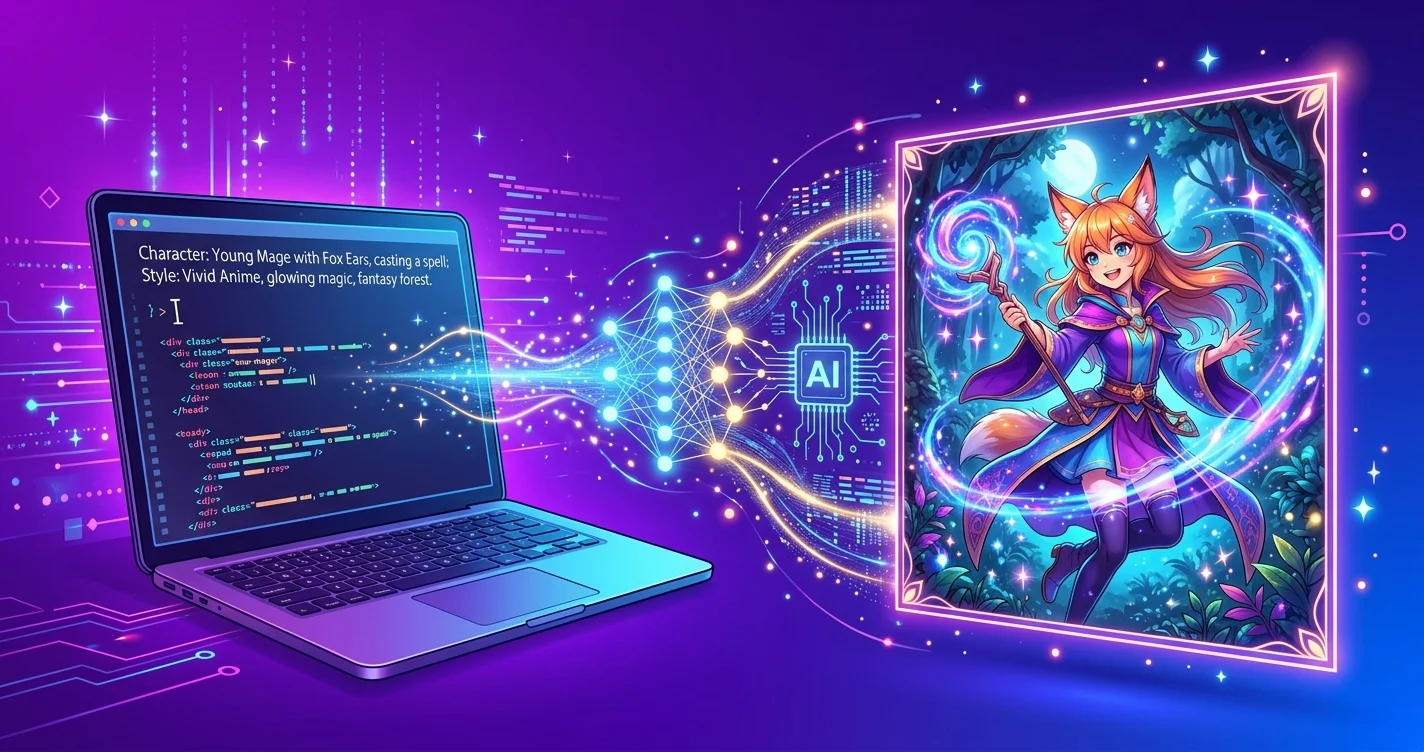
You don’t need to spend years learning to draw to create anime art anymore. AI anime generators can turn a text prompt — or even a selfie — into studio-quality anime artwork in seconds.
And honestly? The results have gotten ridiculous. We’re not talking about the janky, uncanny-valley stuff from 2024. The best tools in 2026 produce art that looks like it belongs in a real manga panel or anime opening sequence.
I’ve tested every major AI anime generator out there. Here’s what actually delivers — and what’s just hype.
What Makes a Good AI Anime Generator?
Not all AI art tools handle anime well. Here’s what matters:
- Style accuracy — Does it actually look like anime? Or just “vaguely cartoon”? The best tools nail specific sub-styles: shonen, shoujo, chibi, mecha, Studio Ghibli-inspired.
- Photo-to-anime quality — Turning a real photo into anime art is harder than text-to-image. Bad tools produce blurry, distorted faces. Good ones preserve your likeness while adding genuine anime flair.
- Consistency — Can you generate multiple images of the same character? This matters if you’re creating content, building a visual novel, or designing characters for a project.
- Resolution and detail — Low-res anime art looks terrible. You want crisp lines, detailed shading, and at least 1024×1024 output.
Best AI Anime Generators in 2026
1. Midjourney — Best Overall for Anime Art
Midjourney remains the gold standard for AI-generated anime art. Its v6.1 model handles anime styles beautifully — from dramatic action scenes to soft, pastel slice-of-life aesthetics.
The trick is in the prompting. Adding style tags like “–niji” (their anime-specific mode) or referencing specific aesthetics (“studio ghibli watercolor,” “90s retro anime,” “dark seinen”) gets you results that genuinely rival professional illustration.
Best for: Creators who want the highest quality anime art with granular style control.
Pricing: From $10/month (Basic plan).
Standout feature: Niji mode — a dedicated anime model trained specifically on anime and manga artwork.
2. Stable Diffusion + Anime Models — Best for Free and Customizable
If you’re willing to get a little technical, Stable Diffusion with community anime models (like Anything V5, Counterfeit, or AOM3) produces some of the best anime art available — and it’s completely free.
The anime community around Stable Diffusion is massive. CivitAI alone hosts thousands of fine-tuned anime models, each specialized for different styles. Want chibi characters? There’s a model for that. Mecha designs? Got it. Realistic anime portraits? Multiple options.
Best for: Artists and enthusiasts who want maximum control and don’t mind a learning curve.
Pricing: Free (runs locally or via free cloud services like Google Colab).
Standout feature: ControlNet — guide the AI’s composition with pose references, depth maps, or sketches.
3. NovelAI — Best for Character Consistency
NovelAI started as a storytelling tool, but their image generator has become one of the best dedicated anime art tools available. Their V3 model is trained almost exclusively on anime and manga — so it just gets the style without needing elaborate prompts.
The killer feature is character consistency. You can create a character sheet and generate that same character in different poses, outfits, and scenes. That’s huge for visual novel creators, webcomic artists, and anyone building a narrative.
Best for: Visual novel creators, character designers, and storytellers.
Pricing: From $10/month (Tablet tier).
Standout feature: Vibe Transfer — upload a reference image and the AI matches the exact art style.
4. Cagliostro (Waifu Diffusion) — Best Free Option
Waifu Diffusion models — evolved into the Cagliostro project — are purpose-built for anime generation. They’re open-source, free, and produce surprisingly good results for the price tag of zero dollars.
The quality isn’t quite Midjourney-level, but it’s more than good enough for social media content, profile pictures, and casual creative projects. And because it’s open-source, the community constantly improves it.
Best for: Hobbyists and creators on a budget who want decent anime art for free.
Pricing: Free.
Standout feature: Runs locally on consumer hardware — no subscription, no cloud dependency.
5. ProfilePicture.AI — Best for Photo-to-Anime
Want to turn your actual photo into anime art? ProfilePicture.AI does this better than most. Upload a selfie, pick an anime style, and get back a stylized version that actually looks like you — just in anime form.
It’s particularly good for social media avatars, team pages, and personal branding. The results are clean, high-res, and don’t have that weird “AI tried to draw a face” quality that plagues cheaper tools.
Best for: Anyone who wants an anime version of themselves for profiles and branding.
Pricing: Free tier available, Pro from $9/month.
Standout feature: Batch processing — upload multiple photos and get anime versions of your whole team.
6. Leonardo.ai — Best for Anime + Other Styles
Leonardo.ai is a versatile AI art platform that handles anime well alongside other styles. Their community-trained anime models are solid, and the platform’s UI makes it easy to experiment with different looks.
If you need anime art and other styles (product mockups, realistic images, concept art), Leonardo is the most practical all-in-one option.
Best for: Creators who need anime art as part of a broader content toolkit.
Pricing: Free tier (150 tokens/day), Pro from $12/month.
Standout feature: AI Canvas — inpaint and outpaint anime images to extend scenes or fix details.
7. PicLumen — Best for Quick Anime Portraits
PicLumen is a newer entry focused on speed and simplicity. It won’t give you the customization depth of Midjourney or Stable Diffusion, but for quick anime portraits and character art, it’s fast and surprisingly good.
Best for: Quick anime art without a learning curve.
Pricing: Free tier available.
Standout feature: One-click anime style presets — choose a look and generate instantly.
How to Create Anime Art with AI (Step by Step)
Here’s the fastest path to great anime art:
- Choose your approach — Text-to-anime (describe what you want) or photo-to-anime (upload a reference image).
- Pick the right tool — Midjourney for quality, NovelAI for characters, ProfilePicture.AI for selfie conversion, Stable Diffusion for free.
- Write a detailed prompt — “Anime girl with silver hair, red eyes, wearing a black coat, standing on a rooftop at sunset, dramatic lighting, shonen style, detailed background” works way better than “anime girl.”
- Iterate — Generate 3-4 variations. Pick the best one. Refine your prompt based on what you like and don’t like.
- Upscale and export — Most tools offer 2x or 4x upscaling. Always upscale before using your art anywhere.
Free vs. Paid: Is It Worth Upgrading?
Honestly? For casual use, free tools are fine. Stable Diffusion and Waifu Diffusion give you excellent anime art at no cost — if you’re willing to set them up.
Paid tools like Midjourney and NovelAI are worth it when you need:
- Consistent quality without prompt engineering expertise
- Character consistency across multiple images
- Speed — no waiting in queues or managing local GPU resources
- Commercial rights for published content
For solopreneurs and content creators, a $10/month subscription pays for itself after your first batch of custom anime visuals.
Using AI Anime Art for Business
This isn’t just for fun. AI anime art has real business applications:
- Social media content — Anime-style posts consistently outperform stock photos in engagement
- Brand mascots — Create a unique anime character for your brand without hiring an illustrator
- Product visualization — Anime-style product shots for merch, digital products, or creative campaigns
- YouTube thumbnails — Eye-catching anime thumbnails drive higher click-through rates
Check out our AI tools directory for more creative tools — we track 169+ AI tools across every category, including RepublicLabs.ai and Magai for broader image generation needs.
The Bottom Line
The best AI anime generator depends on your use case:
- Highest quality → Midjourney (Niji mode)
- Character consistency → NovelAI
- Free and customizable → Stable Diffusion + anime models
- Photo to anime → ProfilePicture.AI
- All-in-one platform → Leonardo.ai
- Quick and simple → PicLumen
The tools are good enough now that creating anime art is no longer about skill — it’s about imagination. The only limit is what you can describe.